Liquid Grip vs. Block Chalk: The Physics of Barbell Friction & Skin Bonding
Why cheap limestone binders ruin deadlifts and how pharmaceutical ethanol delivery guarantees zero chalk dusting in strict commercial gyms.
In a maximal deadlift, your hands are the sole point of transmission between hundreds of kilograms of cold iron and your posterior kinetic chain. If your grip fails by a millimeter, the lift is over—regardless of how powerful your glutes and spinal erectors are.
Yet thousands of athletes buy generic gym chalk without understanding the friction coefficients that govern hand-to-barbell contact.
1. The Chemistry of Hand Perspiration
Human palms contain the highest density of eccrine sweat glands on the human body (up to 700 glands per square centimeter). Under heavy neural stress, these glands secrete sodium chloride, lactic acid, and water.
Magnesium carbonate (MgCO3) is insoluble in water. When applied to the skin, it adsorbs sweat without dissolving, preventing an aqueous lubricating film from forming between the ridges of your skin and the steel knurling.
Pure magnesium carbonate creates a dry mechanical interface, allowing steel knurling to bite into the skin without hydroplaning.
2. The Danger of Filler Clays and Talc
To cut production costs, many budget suppliers dilute their chalk blocks with calcium carbonate (limestone) or hydrous magnesium silicate (talcum powder).
Talc is chemically slippery and is used in industry as an anti-friction lubricant. When talc-adulterated chalk mixes with palm sweat, it forms a pasty sludge that fills in the knurling grooves, making the barbell slicker than dry steel.
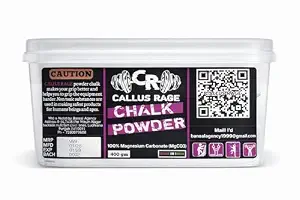
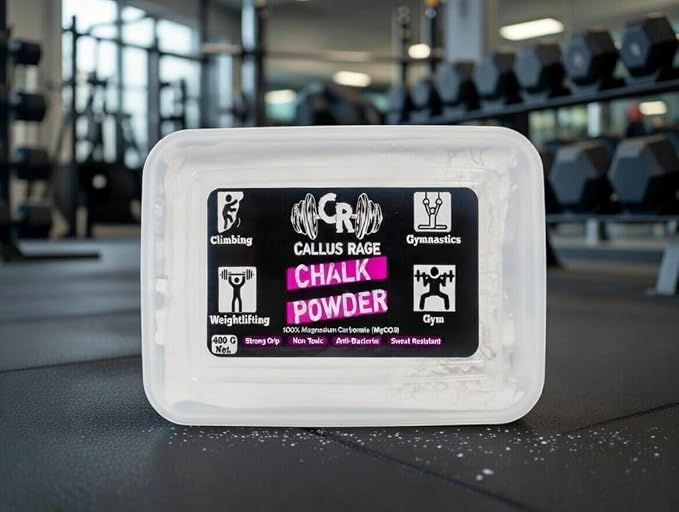
Avoid any chalk containing talc or limestone. Pure lab-grade magnesium carbonate is the only compound that maintains grip integrity under sweat.
3. Why Liquid Chalk Outperforms in Humid Climates
Liquid chalk suspends pure magnesium carbonate in high-proof isopropyl alcohol or ethanol. When rubbed over the palms, the alcohol penetrates deep into the micro-crevices and epidermal dermal ridges of the hand.
Within 15 seconds, the alcohol flashes off (evaporates), leaving an ultra-thin, uniform dry foundation bonded to the skin. Unlike chalk dust, it does not blow away, does not soil gym air, and will not rub off on weight plates.
Liquid chalk bonds to microscopic skin ridges and will not blow away or create messy dust clouds in strict commercial facilities.
4. The Perfect Chalk Layering Protocol
For optimal grip in hot or humid Indian training environments, employ the 'Base Layer' technique: wash your hands with dish soap to strip skin sebum oils, apply a nickel-sized drop of Liquid Rage, rub thoroughly, and let it dry for 20 seconds.
For heavy deadlift singles or platform attempts, lightly dust the tips of the fingers with a Call Us Rage block for unmatched friction.
Wash hands first, apply liquid chalk as a dry foundation, and dust block chalk on fingertips for platform max attempts.
Platform Summary
Do not let cheap chalk rob you of a PR. Invest in pure lab-grade magnesium carbonate that bonds with your skin and refuses to slip.
Taran Singh
Competitive Powerlifter & Product Engineer • Callus Rage Research & Product Division